Garden Room History: From Medieval Courts to Victorian Garden Rooms
Garden room history follows the shift from medieval walled courts to Victorian garden rooms, showing how boundaries, paths and shelters shaped outdoor use.
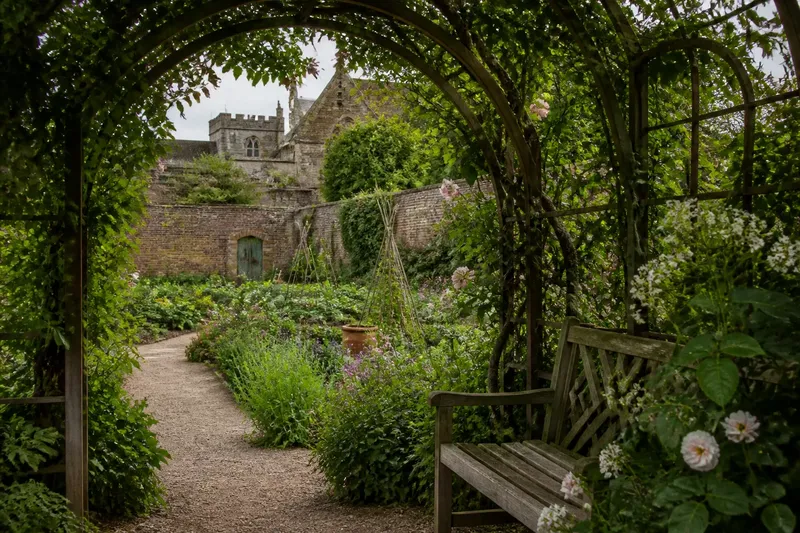
The common mistake in garden room history is to begin with the modern patio, as though outdoor rooms appeared when people added furniture. Medieval European cloister gardens and later English walled gardens offer a more grounded starting point: their enclosing walls shaped cultivated space well before the phrase “garden room” became familiar.
These places served different communities and purposes. Following the sequence from cloister court to Renaissance garden compartment and Victorian garden room shows how enclosure moved between practical, devotional, social and ornamental roles.
Medieval cloister courts
In medieval monasteries, the cloister was a covered walkway arranged around an open court. The court’s walls and arcades separated it from the busier parts of the monastery, while the enclosed plan made it a place for movement, contemplation and daily religious life.
It was not simply a private ornamental garden in the modern sense. Some cloister courts included planted areas, and their enclosed form gave those plantings a distinct setting; the surrounding buildings and religious routines, however, defined the space as much as greenery did.
Medieval walled gardens also had practical roles beyond the cloister. Within a castle or manor, walls could protect cultivated ground and mark it off from surrounding land. The specific use varied by site, so it is safer to read the boundary as evidence of separation and management than to assume every enclosed court was a place for leisure.
Renaissance compartments
In Renaissance gardens, particularly in Italy, designers organised outdoor space into connected parts, using paths, terraces, walls and hedges to control movement and views. A visitor might pass from one area into another, with each compartment offering a different prospect or experience.
This was not a simple replacement of walls by hedges. Both solid and living boundaries could appear in a single designed landscape, and the sequence between them mattered: an opening could frame a view, while a hedge or wall could partly screen the next space.
In England, the formal garden traditions of the Tudor and Stuart periods likewise used compartments and clipped greenery to organise space. The details differed across estates and generations, but the broad design idea was legible: a garden could be composed as a series of distinct places rather than one uninterrupted expanse.
Walled gardens at work
In Britain, the walled garden became especially associated with growing fruit, vegetables and flowers for a household. Its walls helped enclose productive ground and could create a sheltered growing environment. A walled garden was therefore not necessarily a secluded sitting room; its history includes labour, cultivation and household supply.
That practical role helps explain why walls and garden rooms should not be treated as interchangeable. A boundary could define a work area, protect crops or separate cultivation from ornamental grounds. What people did inside depended on the garden’s ownership, layout and purpose.
Victorian garden rooms
By the nineteenth century, garden design in Britain increasingly offered varied experiences within larger grounds. Garden buildings, arbours, trellises and planted enclosures could provide destinations along a route or places to sit apart from the house. The term “garden room” came to describe a more explicit relationship between an outdoor space and the familiar idea of an interior room.
Victorian gardens did not all follow one pattern. A structure might be a decorative retreat, a shelter or part of a larger designed sequence. The important historical change was not the invention of enclosure, but a growing emphasis on distinct outdoor settings that could be experienced as destinations.
Imagine a visitor walking through a Victorian-style garden with a broad lawn, then passing beneath an arbour into a planted nook with a seat. The starting point is an open route; the actual sequence is the framed entrance, a change in view and arrival at the seat. The expected observable result is a clear shift from passing through the grounds to pausing in a defined place, though the arbour does not make the nook a fully enclosed room.
Questions about garden room history?
When did garden rooms begin?
There is no single start date, because enclosed outdoor spaces existed in different forms and served different purposes long before “garden room” became a design label. Medieval cloister courts and walled gardens are useful historical examples, but they were not all garden rooms in the later, recreational sense.
How did medieval cloisters use their courts?
A cloister court sat within a monastery’s covered walkways and was part of a religious community’s daily environment. Its enclosure shaped movement and contemplation, rather than simply providing a domestic leisure space.
Were walled gardens mainly for leisure?
No. In Britain, many walled gardens were associated with cultivating food and flowers for a household, as well as with sheltering and separating productive ground. Their function depended on the site and period.
What changed in Victorian gardens?
Victorian gardens could arrange larger grounds as a sequence of distinct settings, including arbours, garden buildings and planted retreats. Enclosure itself was much older; the later emphasis was on varied destinations and the experience of moving between them.
Reading old enclosures
When you visit a historic garden, look first at what the boundary encloses and how its entrance relates to paths, buildings and working areas. A high wall around productive beds suggests a different use from an arbour beside a route, even if both make a distinct outdoor space.
For garden room history, the most useful question is not whether an old space resembles a modern patio, but what its enclosure made possible in its own setting. That keeps the account attentive to period and place—and helps distinguish a working garden, a cloister court and a designed retreat without forcing them into one category.